
Split-Core vs. Solid-Core Current Transformers: Which One Fits the Job
Both measure current. They do not solve the same problem. A practical comparison of split-core and solid-core CTs for retrofit work, new panels and accuracy-critical metering.
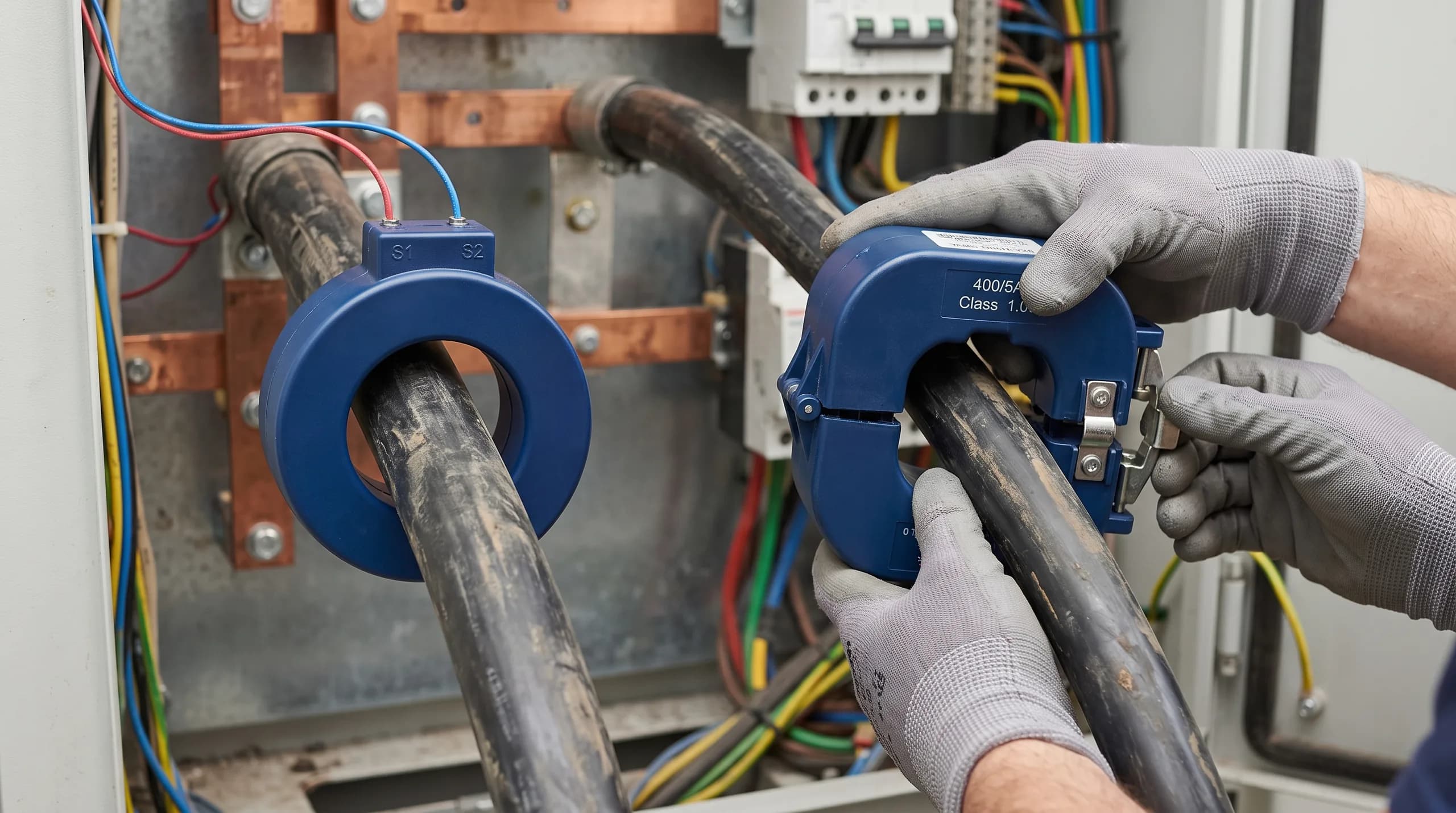
The short answer
Use a solid-core (toroidal) CT in new panels where the primary conductor can be passed through during assembly. Use a split-core CT where the cable or busbar is already installed and cannot be disconnected without a shutdown.
The trade-off is convenience versus accuracy and stability.
Solid-core CTs: the panel builder's default
A solid-core toroidal CT is a closed magnetic circuit. Because the core has no gap, it holds accuracy well, handles burden predictably and is available in tight classes such as 0.5 and 0.2S.
Advantages
- Better accuracy and repeatability
- Higher rated burden for the same size
- Stable performance over temperature and time
- Lower cost for equivalent accuracy
Constraints
- The primary must be fed through the window during build
- Replacement means breaking the conductor
- Window size and busbar geometry must be planned early
For new switchgear, distribution boards and OEM panels, a solid-core CT should be the first choice unless there is a specific reason not to use one.
Split-core CTs: built for retrofit
A split-core CT opens around the conductor, so it can be fitted to a live feeder after isolation at the source. That single feature makes it the standard choice for energy monitoring retrofits, tenant sub-metering and building upgrades.
Advantages
- Installs without dismantling busbars or cable terminations
- Fast on-site deployment, minimal downtime
- Available in large window sizes for existing cables
Constraints
- The air gap reduces accuracy — 1.0 or 3.0 class is typical
- Position and closure quality affect the reading
- Mechanical latch must be fully seated every time
- Less suitable for revenue metering or protection
Split-core devices are measurement tools, not precision instrumentation. Specify them where the goal is consumption visibility, trending or allocation — not billing-grade accuracy.
Comparison at a glance
CriterionSolid-coreSplit-core
Installation
During panel build
Around existing conductor
Typical class
0.2S / 0.5 / 1.0
1.0 / 3.0
Accuracy stability
High
Moderate
Rated burden
Higher
Lower
Best use
New panels, metering, protection
Retrofit, sub-metering
Shutdown required
Yes, to install
Source isolation only
Selection checklist
- Can the conductor be disconnected? If yes, solid-core.
- Is the measurement used for billing or protection? If yes, solid-core with the appropriate class.
- Is this a retrofit with a live busbar? Split-core, and accept the accuracy limit.
- How long is the secondary run? Long runs favour 1 A secondaries and careful burden calculation on either type.
- What is the environment? Vibration and repeated opening shorten the life of split-core latches.
A note on mixed installations
It is common to find split-core CTs added to a panel that already has solid-core metering. That is acceptable for monitoring, but do not compare the two readings and expect them to match to the decimal. Document which circuits use which type, so future maintenance and audits are not misled.
The bottom line
Choose the CT that matches the installation reality, then specify its class honestly. A 1.0-class split-core CT installed correctly will outperform a 0.5-class solid-core unit that was never going to fit.
Ready To Specify Your Next Project?
Our sales engineers work directly with panel builders and procurement teams to specify the right product, confirm lead times, and coordinate international shipping.