
Energy Analyzer or Multifunction Meter? Choosing the Right Instrument
A multifunction meter tells you what the panel is doing. An energy analyzer tells you why. Here is how to decide which one each feeder actually needs — and what to specify either way.
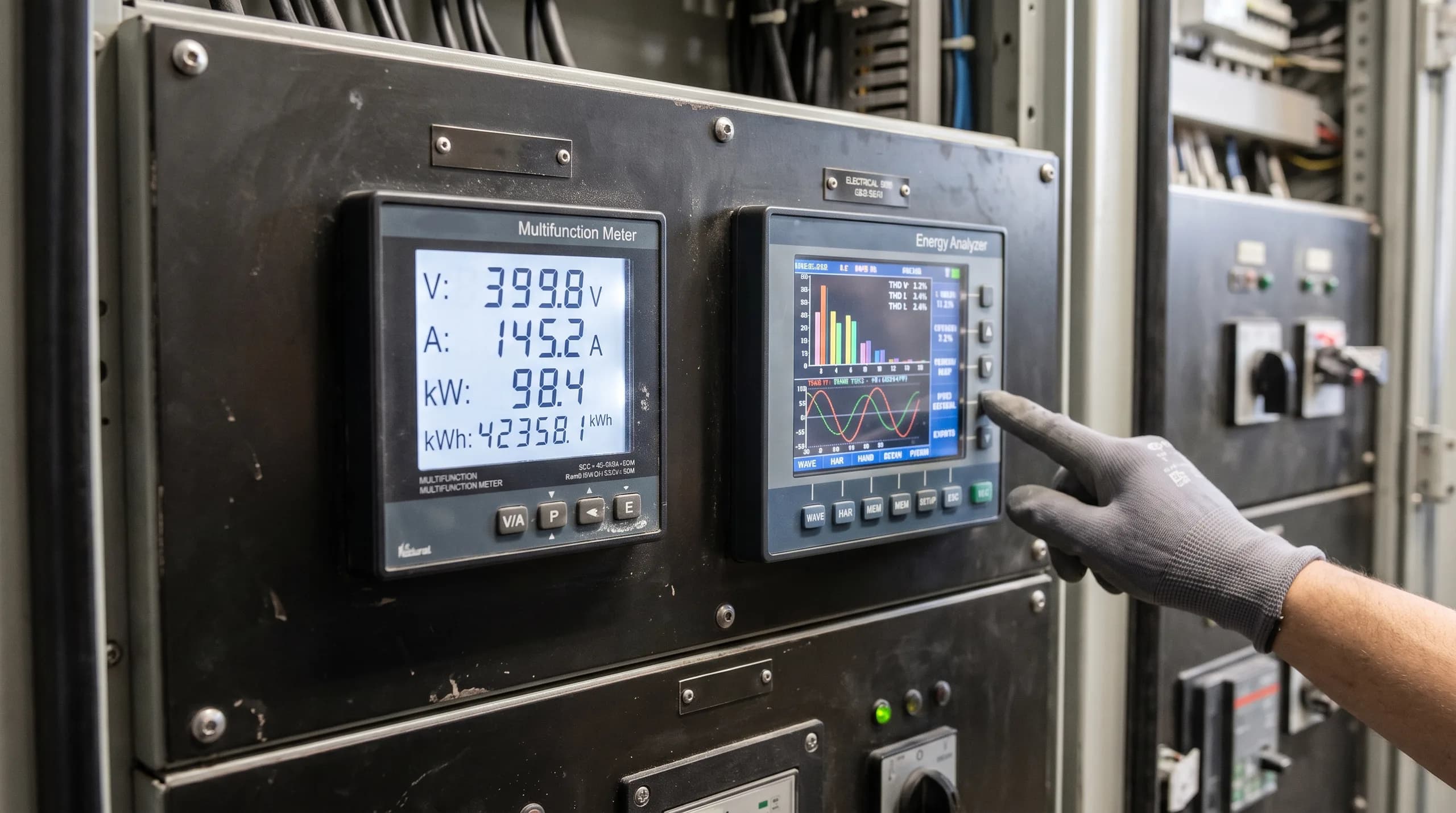
Two instruments, two jobs
The names are often used interchangeably, and that causes both overspending and underspecification. The distinction is simple:
- A multifunction meter measures the standard electrical quantities a panel operator needs: voltage, current, power, power factor, frequency and energy.
- An energy analyzer adds power-quality analysis: harmonics, THD, demand, events, logging and communications.
Both belong in a well-designed panel. The question is where.
What a multifunction meter covers
A good multifunction meter gives you:
- Phase and line voltage, current per phase
- Active, reactive and apparent power
- Power factor and frequency
- Import/export energy
- Min/max logging and a local display
- Often one communication port (Modbus RTU)
That is sufficient for incoming overview, sub-distribution and most OEM equipment panels. If the requirement is "show me the load and let me read kWh", a multifunction meter is the correct and cost-effective choice.
What an energy analyzer adds
An analyzer is specified when the data has to explain behaviour, not just report it:
- Harmonics and THD per phase, to diagnose distortion and overheating
- Demand and peak tracking, for tariff management and capacity planning
- Power-quality events such as sags, swells and interruptions
- Onboard logging, so data survives a communications outage
- Multiple protocols and ports — Modbus RTU and TCP, sometimes BACnet or Profibus
- Digital inputs and outputs for breaker status, alarms or control
These features matter at the incomer, at sensitive loads (VFDs, rectifiers, UPS systems) and anywhere a power-quality dispute is possible.
Where each one belongs
Panel locationTypical choiceWhy
Main incomer
Energy analyzer
PQ events, demand, logging
Feeder to VFD or rectifier
Energy analyzer
Harmonic visibility
Standard distribution feeder
Multifunction meter
Cost-effective overview
OEM machine panel
Multifunction meter
kWh and load display
Tenant sub-metering
Multifunction meter
Allocation, not analysis
Capacitor bank feeder
Analyzer or PF controller
Verify correction and distortion
What to specify either way
- Accuracy class — 0.5S or 0.2S for billing-related points; 1.0 is fine for indication.
- CT and VT ratios — confirm the meter supports the ratios you will install.
- Sampling and refresh rate — relevant for fluctuating loads and harmonic capture.
- Communication — protocol, port count and baud rate must match the BMS or SCADA.
- Memory — how many days of logging at your interval?
- Supply and input range — auxiliary supply, measured voltage and current ranges.
- Mounting and display — DIN rail or panel cut-out, and whether local reading is required.
The mistake to avoid
The most common specification error is putting an analyzer on every feeder "for completeness". It adds cost, wiring and configuration work without adding information anyone uses. Put analyzers where decisions are made — the incomer, the problematic loads — and multifunction meters everywhere else.
The second most common error is the opposite: specifying a basic meter on a feeder feeding drives, then discovering harmonics are the reason the neutral is overheating.
A practical default
For a typical LV distribution panel: one energy analyzer at the incomer, a multifunction meter on each outgoing feeder, and a dedicated analyzer on any feeder supplying electronics-heavy loads. That combination gives full coverage without over-instrumenting the board.
Ready To Specify Your Next Project?
Our sales engineers work directly with panel builders and procurement teams to specify the right product, confirm lead times, and coordinate international shipping.